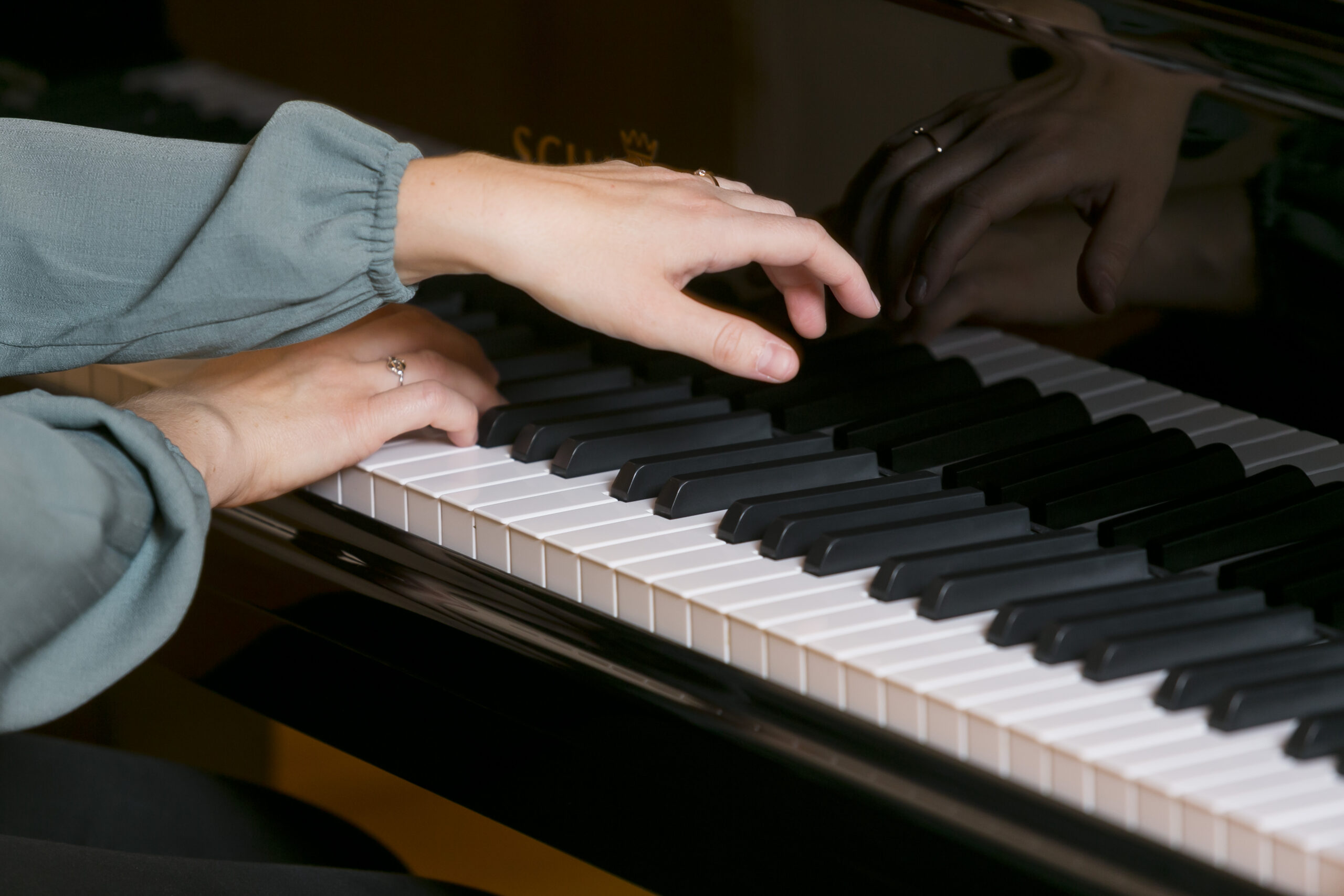
The writer Robert Schneider met with pianist Hanna Bachmann in her hometown of Röthis in Vorarlberg. Kronenzeitung, Oct 19th 2025
The chief conductor of the Berlin Philharmonic, Kirill Petrenko, is enthusiastic about her playing and describes her as a “mature personality at the piano.” Born in 1993, pianist Hanna Bachmann from Röthis has already enjoyed a small international career. She has toured the United States, Mexico, Canada, Israel, and Saudi Arabia. She has performed in some of the most prestigious concert venues, including the Vienna Musikverein, the Beethoven House in Bonn, and the Berlin Philharmonie. With her enchanting recording of Beethoven’s Diabelli Variations in 2018, she attracted considerable attention. One of her special concerns is to present rarely performed piano repertoire and unusual concert programs.
She has always remained true to her roots, even though she now lives in Vienna. In Röthis, Hanna Bachmann has established a concert series where she presents her music freely, beyond well-trodden paths. The “Röthner Schlössle” has become something of her personal laboratory. There, she experiments with ideas that may later succeed in major concert halls. We meet for an interview at the café “SeeYou” in Röthis, just a few meters from her parents’ house. Over Linzer torte and coffee, I discover that – besides our shared love of music – we have something else in common. Hanna’s grandfather used to run a cold-storage facility. As a boy, I often went there. That was back in the days before home freezers existed. My father rented a freezer compartment from the Bachmann family, and from time to time I would go with him to Röthis to pick up meat. In Vorarlberg, everything seems to come together again in unexpected ways.
Hanna, how did you come to music?
My mom and my godmother played the accordion as children, but my mom always wanted a piano. That wasn’t financially possible at first, so she saved for it. With some help from my grandfather, she was finally able to buy one and take lessons. I must have been about five years old at the time and was completely fascinated by the instrument.
That’s how my boys were, too – enthusiastic about banging on it and making noise. Did anyone try to turn you into a child prodigy?
Not at all! A certain basic musical education was important to my parents, but if I hadn’t liked it, they would never have put me under pressure. No, I really wanted to play the piano. They kept saying I was still too small, but I just wouldn’t give up until I finally got half an hour of lessons per week. I loved practicing so much.
I have to interrupt you there – practicing? You loved it? You’re not pulling my leg, are you?
Absolutely! Well, jokes aside – especially during the COVID period, I realized how much I need a goal that I set for myself. For me, practicing is almost like meditation. Often, it gives me more than performing in a concert. Of course, I appreciate the applause and feedback – positive or critical – but when I practice, I’m completely with myself.
A solo piano career requires incredible self-discipline. Where does yours come from?
I definitely got that from my parents: work comes first, then pleasure.
You were one of the youngest students in Ferenc Bognár’s class at the state conservatory. He only accepted the very best. What was his teaching like?
Very inspiring and motivating. I always paid attention to what repertoire the others were playing – I wanted to be able to play that also. One of my fellow students was practicing Beethoven’s Waldstein Sonata at the time…
…and little Hanna decided she wanted to play it too!
Exactly. I was probably quite demanding, maybe even overwhelming at times. I always addressed him formally. When he finally offered me the informal “du” during a concert tour in Hungary, it felt like a great honor for me.
You studied with Florian Krumpöck in Vienna and at the Mozarteum in Salzburg with Pavel Gililov. How did these teachers influence you?
Even during my final school years, I commuted to Vienna to study with Florian Krumpöck. I remember him saying, “You learn the most from the things that are too difficult for you.” That’s a fine line to walk. I always sought out challenges, and toward the end of my studies, I was determined to play Beethoven’s Diabelli Variations. Pavel Gililov was quite hesitant, saying the work was enormous, incredibly complex, and a huge undertaking. But I had already studied it over the summer. I put the score on the stand and played it for him.
You also recorded the Diabelli Variations for the Gramola label. What fascinates you about this work?
It’s simply an amazig piece – full of humour. The more time you spend with it, the more details you discover. I also wrote my thesis about it and performed it at my graduation concert.
Is there such a thing as a distinctive “Hanna Bachmann sound”?
That’s hard to answer. I don’t think it’s about trying to be original at all costs. I come more from an analytical perspective. In concert, I try to switch off the inner critic and sing at the piano.
Thank you, Hanna – and now let’s go take a look at your grandfather’s former cold-storage facility!
With pleasure!