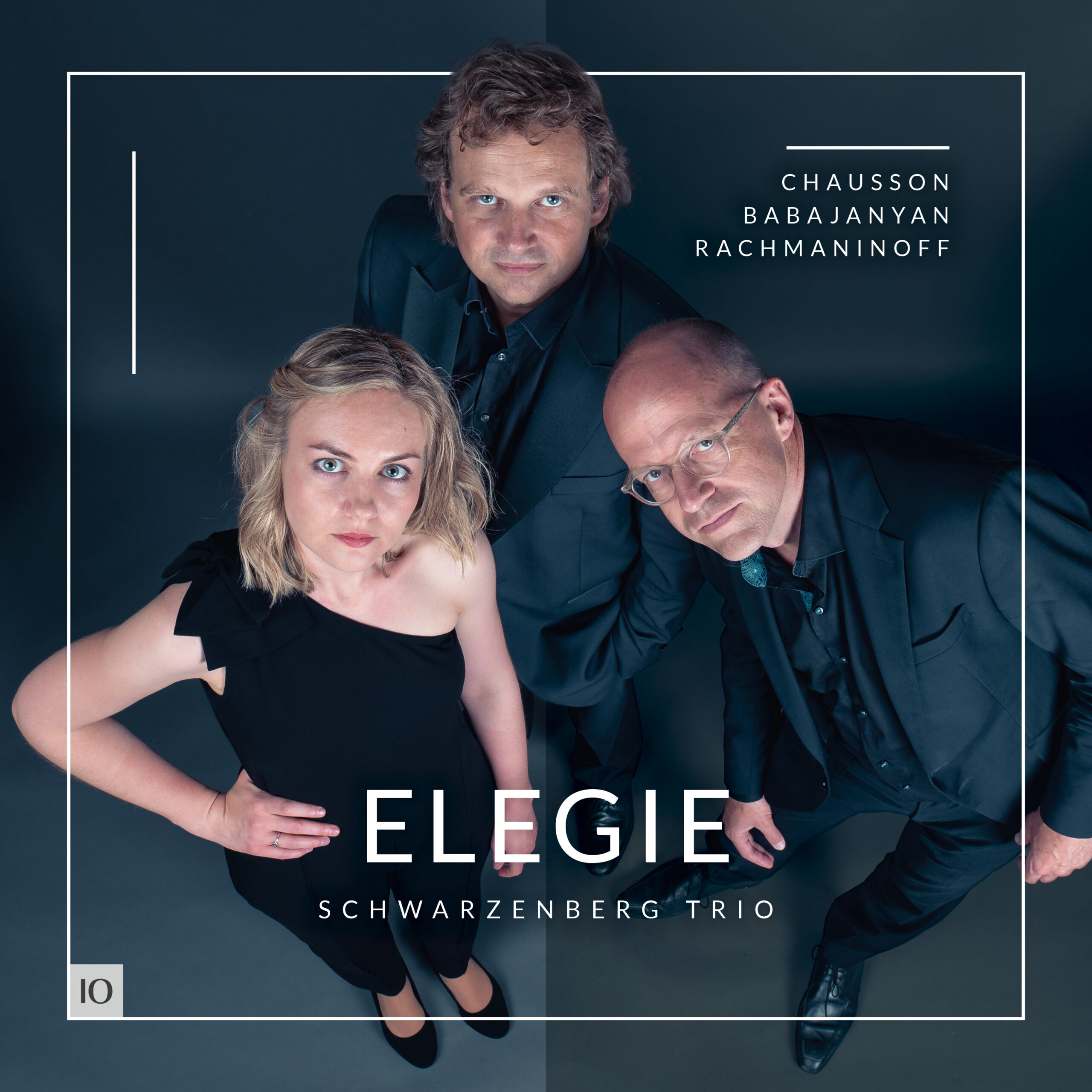
CD Review by Walter Eigenmann in the Glarean Magazine
With Ernest Chausson’s Piano Trio, Op. 3, Sergei Rachmaninoff’s Trio élégiaque No. 1, and Arno Babajanian’s Trio in F-sharp minor, the Schwarzenberg Trio — pianist Hanna Bachmann, violinist Franz-Markus Siegert, and cellist Roland Lindenthal — explores three works that, across the worlds of French late Romanticism, Russian elegiac expression, and Soviet-Armenian modernism, illuminate a common tradition of heightened emotional intensity and densely woven musical texture.
The three works recorded here, composed between 1881 and 1952, have—with the possible exception of Rachmaninoff’s Trio élégiaque, which has recently enjoyed something of a revival—refused to court the demands of the by now alarmingly diminished chamber music market. Yet despite their fundamentally different cultural backgrounds, these pieces share a common aesthetic outlook: an uncompromising pursuit of heightened expressivity within a broad musical architecture whose sound world is at times almost orchestral in scope, combined with a distinctive national stylistic colouring and a harmonic language firmly rooted in the late Romantic tradition.
Chromatic richness combined with…
Ernest Chausson’s Piano Trio, Op. 3, still unmistakably bears the influence of César Franck and his concept of cyclical form, yet it already reveals the chromatic richness and harmonic sensitivity that would later become hallmarks of French fin-de-siècle music. Sergei Rachmaninoff’s early Trio élégiaque, by contrast, draws on the Russian piano trio tradition with its fundamentally elegiac character — a homage to Tchaikovsky unfolding in a broad, expansive musical arc. The programme’s true — and most welcome — maverick, however, is Arno Babajanian. His Trio in F-sharp minor combines the expressive intensity of early modernism with Armenian melodies inflected by modal harmony and rhythmic impulses rooted in folk tradition. To this day, it remains a singular work within the twentieth-century piano trio repertoire.
…textural transparency and rhythmic clarity
This is also where the particular programmatic strength of this Elegie album lies: its focus is not on simply reproducing the same familiar (classical) canon yet again, but on expanding that canon with two works that are rarely heard in the concert hall, despite being compelling representatives of their genre. The way in which the ensemble around the renowned pianist Hanna Bachmann approaches this deliberately broad artistic horizon can be observed especially clearly in its interpretation of the Rachmaninoff Trio. Whereas other recordings tend to fragment the work’s episodic character through overtly dramatic dynamics, excessive stretching of tempi, and heavily emphasized delays in the musical flow, this interpretation stands out for its comparatively tighter sense of pacing and its detail-oriented continuity. As a result, the work’s structural design emerges with striking clarity, also reflected in the generally more streamlined tempi. The major processes of intensification in the score, which other ensembles often turn into massive accumulations of sound, remain controlled and compact here. The Schwarzenberg Trio places less emphasis on demonstrative emotionalism than on rhythmic stability, sonic transparency, and the perceptibility of the large-scale arcs of tension. The relatively intimate recording perspective further enhances this impression, clearly tracing the motivic interconnections and the inner movements of the music.
A Brilliant Dance Apotheosis in Babajanian
Unfortunately, this sense of clarity and inner detail is somewhat diminished in the technically most demanding movement of the three works: the Allegro vivace of Babajanian’s Trio, a brilliant dance apotheosis. Here, in my view, the Armenian composer’s spirited rhythmic and chordal filigree—Khachaturian, his compatriot, is unmistakably present in spirit—would have benefited from a slightly less “thickening” recording approach, with less reverberant acoustics. For me personally, the benchmark in this respect remains the transparent, highly precise recording by David Oistrakh and cellist Sviatoslav Knushevitsky, with the composer himself at the piano; the Z.E.N. Trio’s recording on Deutsche Grammophon comes closest to matching it.
Recorded in February 2025 at the Bösendorfer piano factory in Wiener Neustadt on a Bösendorfer 280 Vienna Concert grand piano, the album presents the Schwarzenberg Trio at a high level of technical mastery, with a strong fidelity to the score and a thoughtful shaping of the music’s inner architecture. A welcome addition to the catalogue, the recording sheds new light on all three composers represented here.
Walter Eigenmann in the Glarean Magazine