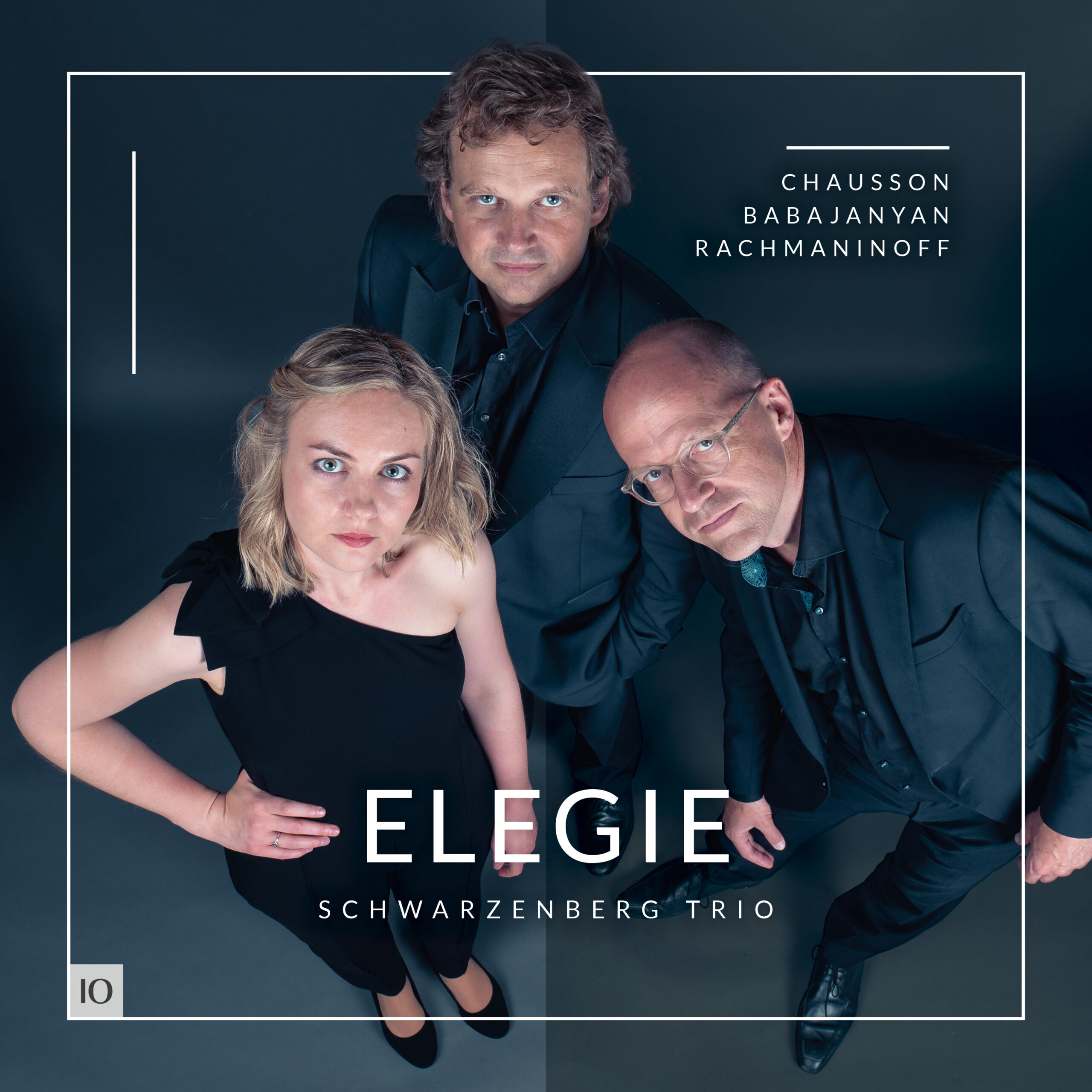
by Holger Sambale on klassik-heute.de
Founded in its original line-up as early as 2009, the Schwarzenberg Trio—named after Vienna’s Café Schwarzenberg—re-formed several years ago with cellist Roland Lindenthal and has since begun an active recording career in this configuration. This new release marks the ensemble’s second album. While the debut brought together works by Beethoven, Mendelssohn Bartholdy, and Werner Pirchner, the present selection of Chausson, Babajanian, and Rachmaninoff reveals a trio that embraces a broad and varied repertoire with considerable curiosity.
Elegiacly Shaped Trios of the Late Romantic Era
The term “Elegie” (Elegy), which gives the new album its title, refers not only to Sergei Rachmaninoff’s Piano Trio No. 1 in G minor (1892), a single-movement work published only posthumously, which—like its much larger-scale companion piece—is designated as a Trio élégiaque. Here, however, the term is perhaps to be understood less in the sense of a commemorative work than as the evocation of a particular underlying mood (despite the funeral march at the conclusion).
The other two works, too, are dominated by darker hues. In Ernest Chausson’s early Piano Trio in G minor, Op. 3 (1881), the elegiac character—particularly in the magnificent third movement—is shaped to a certain extent by the influence of César Franck’s Piano Quintet, composed shortly beforehand. Even the Scherzo, which essentially functions as an airy interlude, does not entirely avoid more muted and restrained shades of expression. And by the time, at the end of the Finale, the main theme of the first movement returns—having begun in the initially relaxed world of G major—and drives the music toward a sombre conclusion, the work takes on a distinctly fatalistic character.
An expressive approach to Armenian folk music
The booklet texts on the three works were written by the three members of the trio themselves and are presented more in the spirit of personal reflections. In the case of the third and chronologically most recent trio on the album, it is cellist Roland Lindenthal who first admits that he was previously unfamiliar with the Armenian composer Arno Babajanian (1921–1983). This is probably true of many musicians; and yet Babajanian was, on the one hand, a central figure in the Armenian music of his generation and, on the other, far from an unknown quantity when examined more closely.
His Piano Trio in F-sharp minor (1952), in particular, has been recorded several times: as early as 1953 by Babajanian himself together with the dedicatees David Oistrakh and Sviatoslav Knushevitsky, and more recently—fortunately—by several ensembles of our time. Among the trio of Armenian composers of his generation (alongside Alexander Arutiunian and Eduard Mirzoyan), Babajanian was the one who engaged most intensively with more modern tendencies. This is not necessarily immediately apparent in the work itself; nevertheless, its passionate intensity and its approach to Armenian folk traditions—placing particular emphasis on expressive power—are already characteristic of Babajanian’s later compositions as well.
Refined, elegant, and distinguished interpretations
In these three works, which are thus fundamentally related in character, the Schwarzenberg Trio proves itself to be an exceptionally cultivated ensemble, performing with finely attuned interplay and placing less emphasis on uncompromising expressive sharpness than on a certain underlying elegance—here, one dominated by melancholy. This becomes particularly evident in Babajanian’s Trio, whose opening movement the Schwarzenberg Trio approaches in a considerably more restrained and introspective manner than the composer himself does at the piano. The work allows for both interpretations, although I would personally grant at least such rhythmically incisive passages as the Più mosso shortly before rehearsal numbers 10 and 15 a little more untamed, elemental force—the distance from this point to the aggressively dissonant closing bars of Babajanian’s Cello Concerto of 1962 is not so great.
Much of the ensemble’s playing is highly accomplished; one need only listen to Hanna Bachmann’s refined and delicate piano writing at the beginning of Rachmaninoff’s Trio, or to the lyrical dialogue between Franz-Markus Siegert and Roland Lindenthal in the slow movements of the trios by Chausson and Babajanian. Here and there, the transitions might perhaps benefit from a touch more flexibility, from a more conscious savoring of newly emerging harmonic and atmospheric centres—but these are already matters of subtle refinement at a very high level.
Overall, this is a successful and highly recommendable album that leaves one eager to follow the ensemble’s further artistic journey.